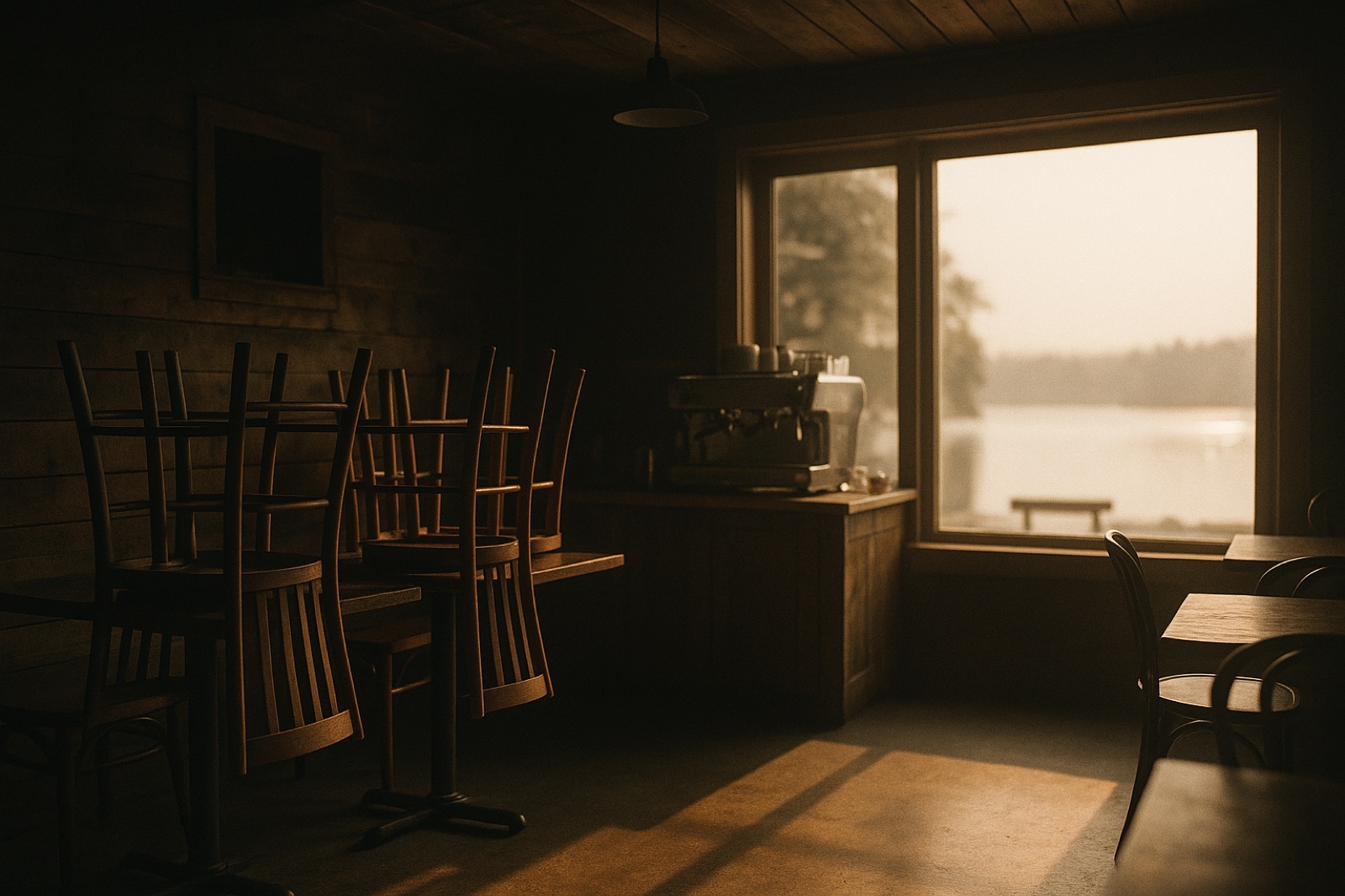
Before the first customer walks in, a cafe is just a room. The chairs are still down. The espresso machine is cold. The light comes in low across the floor and nothing has happened yet. I've stood in that room a few hundred mornings now, and it never stops being my favorite part of the day — the quiet right before a summer that has to carry the whole year.
That's the thing people don't always get about a seasonal cafe. It isn't a year-round business that's busier in summer. It's basically a four-month business. June, July, August, with a little shoulder on either side, and then a long quiet stretch where the town empties out. Everything rides on a handful of warm weeks. There's a clarity in that. You don't get to coast.
The whole cafe is an art project
I didn't come up through food. I came up through marketing — more than seven years of it — plus video production, photography, and web design, the whole creative-services stack. I freelanced in the San Francisco Bay Area, and for a while it was a real living. But the work was always the same shape: pour everything I had into building someone else's brand, hand it over, move on to the next client. The photography end especially had gotten brutal — the gear got cheap and good, everyone with a phone became a photographer, and the jobs that still paid turned into a grind of marketing myself for less than the work used to be worth.
What I actually wanted was to aim all of it at something of my own. Take the marketing, the video, the photography, the design — the skills I'd spent years renting out to other people — and pour them into my own brand instead of theirs. And I'd fallen hard for the cafe environment on top of that: being in a room full of people, making something with my hands, the back-and-forth across a counter. I'd rather pull a hundred drinks and talk to a hundred people than spend another afternoon editing someone else's photos alone. So instead of chasing the next client, I built the place I actually wanted to stand in.
And once I saw it that way, the cafe stopped being "a business" and turned into the canvas. The menu, the drinks, the food, the color, the music, the light, the physical space — all of it is something I get to make and keep remaking. The whole cafe is an art project, and like any art project, what you put into it is what you get out. That's the part I love: it's a creative outlet that also happens to be an open door to the public, every single day.
We didn't open the cafe because we had a grand plan. We opened it because we kept looking for clean, real food where we live and coming up short. After enough years of that, the frustration turned into a decision: fine, we'll make the thing we can't find. That sentence is more or less the whole story of everything I've built since.
The chai gave it away
The clearest version of the lesson was the chai. Early on, someone pointed us at the standard cafe move — a pump bottle of chai syrup. I turned the bottle around and read the label: corn syrup, "natural flavors," a list of things I couldn't pronounce. We poured it out. Then we made our own from scratch, real spices, no shortcuts, and put it on the menu.
For years, the house chai was the thing people remembered. Not the pastries, not the coffee — the chai. And the question I heard most across the counter wasn't about the cafe at all. It was: where can I get this at home? I tried to send them somewhere. I really looked. Everything I found was either loaded with sugar or tasted like cardboard. So we packaged our exact recipe and put it online, and that became Meria Chai — a thing that started as a drink at a counter and turned into something you can order to your kitchen.
That's the pattern. A real product, made because the honest version didn't exist, that customers want to take home with them. Once you've watched it happen once, you start seeing the same shape everywhere.
When you can't find the thing you want, make it. That's more or less the whole story of everything I've built.
The cafe is the launchpad, not the goal
People sometimes assume the software is a distraction from the cafe, or the cafe is a fallback for the software. Neither is right. The cafe is the foundation. It's real, it's mine, and it's the room where I find out what actually works in front of customers — and that footing is exactly what lets me build the rest without betting everything on any one app.
It's also the best product lab I could ask for, because I'm customer number one for half of what I make. The line gets long in July, so I built kiosk software and put it on iPads in my own shop before I ever showed it to another business. That's Order June. The room needed the right music every morning and nothing fit, so I built Puana to play it. I had too much going on to hold the schedule in my head, so I built Composed. None of those came out of a strategy deck. They came out of standing in that room before open, annoyed at a real problem, with the tools to fix it.
The seasons help more than they hurt. Summer is for running the room; the quiet months are when I build. That's the rhythm now — the cafe is the footing, and a footing is exactly what you need before you can take a swing at anything bigger. Lately the swing has been software, most of it made in the off-season, often with AI doing the parts I couldn't have done alone. The off-season is the time. I spend it building.
Build what you can't afford
If I had to put the whole thing on a bumper sticker, it's the line I keep on the front page of my own site: I build everything I can't afford. That's not a money statement, exactly. It's a posture. The good version of the thing I want usually costs more than I'd like, or doesn't exist, or comes wrapped in stuff I don't trust. So I make it. The cafe taught me I could — that "we'll just make it ourselves" is a real option and not a fantasy, even when it's hard and the summer is short.
But "afford" is only half of it. The bigger half is that I notice when something could be better, and then I can't let it go. The kiosk is the clearest example I have. For years I paid about a thousand dollars a year for someone else's kiosk app to run my counter, and it was fine — until I started seeing all the ways it wasn't. I'd email the company and ask if they could change this, add that, fix the thing that made customers hesitate at the screen. They'd thank me for the feedback. Then they wouldn't ship it. Not because they were lazy — it just wasn't their itch the way it was mine.
Honestly, if that app had done what I wanted, I never would have built my own. I didn't even know how to make apps yet, and building a kiosk from scratch turned out to be genuinely hard — I'm still tweaking Order June to this day. But I couldn't stop seeing the better version in my head, and eventually wanting it badly enough beat not knowing how. What runs on my counter now isn't a little better than the thing I used to rent. It's not close.
So the bumper sticker is the start, not the heart. "Build what you can't afford" gets you off the couch. The real engine is the part underneath it: having the idea, noticing the thing everyone else walks right past, and then actually executing on it instead of filing it away with the other someday-maybes. That's the part I'm a little obsessed with — taking something that already exists and making it stubbornly, unreasonably better. Best in the world, if I can get there. The cafe is where I learned I'm allowed to try.
Everything under the Meria name traces back to that room before open. The chai, the apps, the kiosk on the counter, the music in the air. Same instinct every time. Find the gap between what exists and what should, and close it with your own hands.
Come by, or take a little of it home
Cafe Meria is the lakeside cafe where all of this started — clean ingredients, made from scratch, family-run. And the house chai that people kept asking to take home is now a thing you can actually order.
Visit Cafe MeriaHouse chai, smoothies, real espresso · Shop the chai at meriachai.com
If you've read this far, you probably know the feeling I'm describing — that small, stubborn annoyance when the thing you want isn't out there the way it should be. My only real advice is the cafe's whole philosophy: don't wait for someone else to make it. The first time you build the thing you couldn't buy, something changes, and you don't go back.